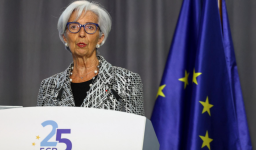
Christine Lagarde, president of the European Central Bank (ECB), stated on Monday that France does not now need the assistance of the International Monetary Fund (IMF). Lagarde went on to say that the state of the French banking system has improved since the 2008 financial crisis.
Important quotations
Any collapse of a Euro-area government is concerning.
The French banking system is not inherently dangerous.
The state of the French banking system has improved after the 2008 financial crisis.
Debt sustainability is crucial for all nations.
At the moment, France is not in a position where the IMF would have to step in.
I am paying close attention to the state of the French bond spreads.
In order to reduce inflation, we shall maintain taking the required actions.
There is far less uncertainty now.
Trump's removal of the Fed head would affect the US economy's equilibrium.And the global economy would be severely impacted by that.
Reaction of the market
The EUR/USD exchange rate is currently up 0.31% for the day at 1.1721.
How does the European Central Bank affect the Euro?
The Eurozone's reserve bank is the European Central Bank (ECB), located in Frankfurt, Germany. The ECB oversees the region's monetary policy and sets interest rates. Maintaining price stability, or limiting inflation at about 2%, is the major responsibility of the ECB. Interest rate changes are its main means of accomplishing this. A stronger Euro is typically the outcome of relatively high interest rates, and vice versa. Eight times a year, the ECB Governing Council meets to decide on monetary policy. Six permanent members, including Christine Lagarde, the president of the European Central Bank, and the presidents of the Eurozone's national banks make decisions.
How does Quantitative Easing (QE) impact the Euro and what is it?
The European Central Bank has the authority to implement quantitative easing as a policy tool in dire circumstances. The ECB creates euros and uses them to purchase assets from banks and other financial institutions, typically corporate or government bonds. This procedure is known as quantitative easing. A weaker Euro is typically the outcome of QE. When merely cutting interest rates is unlikely to accomplish the goal of price stability, quantitative easing (QE) is the last option. The ECB employed it throughout the COVID pandemic, the Great Financial Crisis of 2009–2011, and 2015, when inflation remained stubbornly low.
How does the Euro get affected by quantitative tightening (QT)?
The opposite of QE is quantitative tightening (QT). It is carried out when inflation begins to rise and an economic recovery is under way, following quantitative easing. In QT, the European Central Bank (ECB) stops purchasing new bonds and reinvesting the principal on the assets it already owns, whereas in QE, the ECB buys government and corporate bonds from financial institutions to give them liquidity. For the Euro, it is often bullish or favorable.
Important quotations
Any collapse of a Euro-area government is concerning.
The French banking system is not inherently dangerous.
The state of the French banking system has improved after the 2008 financial crisis.
Debt sustainability is crucial for all nations.
At the moment, France is not in a position where the IMF would have to step in.
I am paying close attention to the state of the French bond spreads.
In order to reduce inflation, we shall maintain taking the required actions.
There is far less uncertainty now.
Trump's removal of the Fed head would affect the US economy's equilibrium.And the global economy would be severely impacted by that.
Reaction of the market
The EUR/USD exchange rate is currently up 0.31% for the day at 1.1721.
How does the European Central Bank affect the Euro?
The Eurozone's reserve bank is the European Central Bank (ECB), located in Frankfurt, Germany. The ECB oversees the region's monetary policy and sets interest rates. Maintaining price stability, or limiting inflation at about 2%, is the major responsibility of the ECB. Interest rate changes are its main means of accomplishing this. A stronger Euro is typically the outcome of relatively high interest rates, and vice versa. Eight times a year, the ECB Governing Council meets to decide on monetary policy. Six permanent members, including Christine Lagarde, the president of the European Central Bank, and the presidents of the Eurozone's national banks make decisions.
How does Quantitative Easing (QE) impact the Euro and what is it?
The European Central Bank has the authority to implement quantitative easing as a policy tool in dire circumstances. The ECB creates euros and uses them to purchase assets from banks and other financial institutions, typically corporate or government bonds. This procedure is known as quantitative easing. A weaker Euro is typically the outcome of QE. When merely cutting interest rates is unlikely to accomplish the goal of price stability, quantitative easing (QE) is the last option. The ECB employed it throughout the COVID pandemic, the Great Financial Crisis of 2009–2011, and 2015, when inflation remained stubbornly low.
How does the Euro get affected by quantitative tightening (QT)?
The opposite of QE is quantitative tightening (QT). It is carried out when inflation begins to rise and an economic recovery is under way, following quantitative easing. In QT, the European Central Bank (ECB) stops purchasing new bonds and reinvesting the principal on the assets it already owns, whereas in QE, the ECB buys government and corporate bonds from financial institutions to give them liquidity. For the Euro, it is often bullish or favorable.